
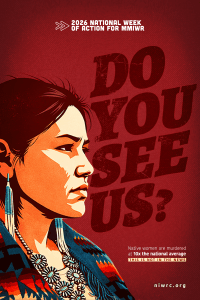
Native women, girls, and Two-Spirit people experience some of the highest rates of violence in the United States. According to the National Indigenous Women’s Resource Center, in some tribal communities, Native women are murdered at rates more than ten times the national average. Yet far too often, these cases go unreported, uninvestigated, and unresolved, leaving families without answers or justice.
Each year, the National Week of Awareness for Missing and Murdered Indigenous Women and Relatives (MMIWR) is observed from May 5 to May 9. This week is a time to honor those who have been taken, demand accountability, and uplift the voices of Indigenous communities leading efforts for change.
The National Day of Awareness on May 5 specifically honors the lives of Indigenous women, girls, Two-Spirit people, and all Indigenous relatives who have been abducted or murdered. It was established in memory of Hanna Harris, a 21 year old member of the Northern Cheyenne Tribe who went missing on July 4, 2013. Hanna's case, like so many others, drew national attention to the crisis of missing and murdered Indigenous peoples and the systemic failures that allow it to persist.
Many of these murders and disappearances are linked to domestic violence, dating violence, sexual assault, stalking, and sex trafficking. Despite the severity of these crimes, systemic barriers, including jurisdictional challenges, racism, and chronic underfunding of investigations, mean that perpetrators are too often not held accountable.
At the New York State Coalition Against Domestic Violence (NYSCADV), we remain committed to supporting Indigenous-led efforts to prevent violence and secure justice. Addressing this crisis requires amplifying Indigenous leadership, advancing systemic reforms, and centering the voices of survivors, families, and communities most impacted.
Take Action: National Week of Awareness (May 5–9, 2026)
As we observe the 2026 National Week of Awareness for MMIWR, we invite you to take meaningful action:
Wear red on May 5 to honor missing and murdered Indigenous relatives. Share your participation using hashtags like #MMIWR, #NoMoreStolenRelatives, and #NationalDayOfAwareness
Host or attend a community event, such as a vigil, prayer circle, or teach-in, to honor those who are missing or have been lost
Lift up names and stories from your community to ensure victims are not forgotten
Engage in advocacy efforts that call for improved data collection, coordinated responses, and accountability across systems
Together, we can honor those who are missing or murdered and work toward ending the violence that disproportionately impacts Indigenous women, girls, Two-Spirit people, and all Indigenous relatives.
Learn More & Support Indigenous Led Efforts
We encourage you to learn from and support organizations leading this work:
Seven Dancers Coalition – A New York-based nonprofit uplifting Indigenous families through education and the restoration of traditional values
StrongHearts Native Helpline (1-844-762-8483) – A 24/7, culturally appropriate, confidential helpline for Native survivors of domestic violence and their loved ones
Mending the Sacred Hoop – A Native led organization working to end violence against Indigenous women through grassroots organizing, training, and advocacy
National Indigenous Women’s Resource Center – The National Indian Resource Center is dedicated to addressing domestic violence and safety for Native women through training, policy, and research
Rematriation – A multimedia initiative uplifting Indigenous voices and reimagining narratives through storytelling, digital content, and community engagement
This blog post aligns with the goals and requirements of the Family Violence Prevention and Services Act (FVPSA), which supports efforts to prevent family violence, domestic violence, and dating violence, and to provide immediate shelter and supportive services for survivors. As outlined in FVPSA, funded programs are intended to “prevent incidents of family violence, domestic violence, and dating violence, and provide immediate shelter and supportive services for victims of such violence, and for their dependents.” This includes advancing culturally specific, community-based approaches that center the needs and leadership of underserved populations, including Indigenous communities.