
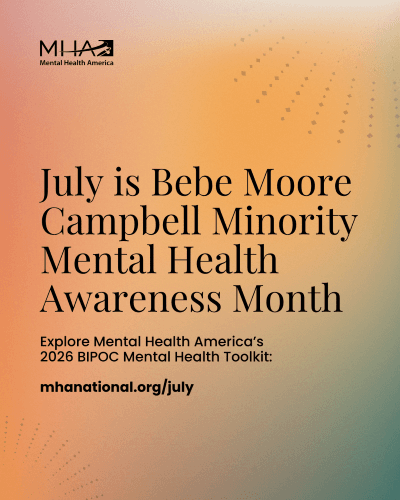
Each July, we recognize Bebe Moore Campbell National Minority Mental Health Awareness Month, also known as BIPOC Mental Health Awareness Month. This observance honors the legacy of author, advocate, and mental health champion Bebe Moore Campbell while bringing attention to the mental health experiences, strengths, and needs of Black, Indigenous, and people of color.
For survivors of domestic violence, mental health and emotional well-being are deeply connected to safety, healing, and the ability to rebuild. Domestic violence can affect a survivor’s mental health in many ways, including increased experiences of anxiety, depression, post-traumatic stress, isolation, grief, and diminished self-esteem.
Although domestic violence occurs across all racial, ethnic, and cultural communities, BIPOC survivors may experience additional challenges when seeking safety and support. Systemic racism, discrimination, economic inequities, immigration concerns, language barriers, and unequal access to health care can shape both a survivor’s experience of abuse and the options available to them.
Some survivors may also face cultural or community stigma related to mental health, domestic violence, or seeking assistance. Concerns about judgment, shame, confidentiality, or being perceived as disloyal to one’s family or community can make it harder to reach out. Survivors may also have understandable concerns about engaging with institutions that have historically harmed or failed their communities.
These barriers should never be interpreted as a survivor's unwillingness to seek help. Instead, they highlight the importance of creating services that are accessible, culturally responsive, trauma-informed, and grounded in each survivor’s individual circumstances and choices.
Supporting Healing Through Culturally Responsive Advocacy
Mental health professionals, domestic violence advocates, health care providers, and community partners all have a role in creating more equitable pathways to safety and healing.
Culturally responsive support begins with listening to survivors and respecting their understanding of their own identities, families, communities, and experiences. It also requires recognizing the impact of systemic oppression and avoiding assumptions about what safety, justice, or healing should look like.
Organizations can strengthen their responses by:
- Partnering with culturally specific and community-based organizations
- Providing interpretation and translated materials
- Increasing representation among staff, leadership, and decision-makers
- Examining policies and practices for racial and cultural bias
- Offering survivor-centered options that respect individual definitions of safety and healing
- Building trust through transparency, consistency, and accountability
- Recognizing community strengths, cultural traditions, and collective approaches to wellness
As we observe BIPOC Mental Health Awareness Month, we encourage advocates, providers, policymakers, and community members to deepen their understanding of the connections among domestic violence, mental health, culture, and systemic inequity.
Supporting BIPOC survivors requires more than increasing awareness. It requires sustained action to remove barriers, invest in culturally specific services, and ensure that every survivor can access care that honors their identity, choices, strengths, and vision for healing.
Mental Health and Survivor Support Resources
The following organizations provide mental health information, domestic violence resources, culturally responsive programming, or opportunities for healing and support.
Mental Health America BIPOC Mental Health Resource Center
Mental Health America offers educational materials, awareness tools, social media resources, and information about the mental health strengths and challenges experienced by BIPOC communities.
Explore Mental Health America’s BIPOC Mental Health resources
NYSCADV Self-Care Toolkit
NYSCADV’s Self-Care Toolkit includes webinars, tools, and resources related to well-being, resilience, and sustainable advocacy. The materials are intended to support advocates and organizations engaged in the challenging work of supporting survivors.
View the NYSCADV Self-Care Toolkit
National Resource Center on Domestic Violence
The National Resource Center on Domestic Violence provides training, technical assistance, research, and resources to strengthen responses to domestic violence. Its work incorporates an intersectional approach and highlights the importance of culturally specific and survivor centered advocacy.
Visit the National Resource Center on Domestic Violence
In Our Own Voices
Located in Albany, In Our Own Voices works to promote the physical, mental, spiritual, political, cultural, and economic well-being of lesbian, gay, bisexual, and transgender people of color, their families, and their communities.
Learn more about In Our Own Voices
The Reconciliation Center and Restore Forward
Formerly known as Black Women’s Blueprint, The Reconciliation Center now operates within Restore Forward. Its work centers healing, reconciliation, collective well-being, and support for people and communities affected by trauma and gender based violence.
Learn more about Restore Forward
NYC 988
Formerly known as NYC Well, NYC 988 provides free and confidential mental health and substance use support to people in New York City. Counselors are available by phone, text, or chat 24 hours a day, seven days a week, with interpretation available in more than 200 languages.
Call or text 988 to connect with a counselor.
New York State Domestic Violence and Sexual Violence Hotline
The New York State Domestic Violence and Sexual Violence Hotline provides confidential assistance and connections to local services.
Call 1-800-942-6906.
Text 844-997-2121.
Chat with an advocate or learn more
If you are in immediate danger or need emergency medical assistance, call 911.
This blog post aligns with the goals and requirements of the Family Violence Prevention and Services Act, or FVPSA, which supports efforts to prevent family violence, domestic violence, and dating violence and to provide immediate shelter and supportive services for survivors. As outlined in FVPSA, funded programs are intended to “prevent incidents of family violence, domestic violence, and dating violence, and provide immediate shelter and supportive services for victims of such violence, and for their dependents.”
Sharing public awareness information about mental health and domestic violence supports these goals by helping advocates, service providers, and communities better understand the effects of trauma and the barriers survivors may face when seeking safety, healing, and support. This includes advancing culturally specific, community-based approaches that center the experiences, needs, strengths, and leadership of underserved populations, including Black, Indigenous, and other communities of color.