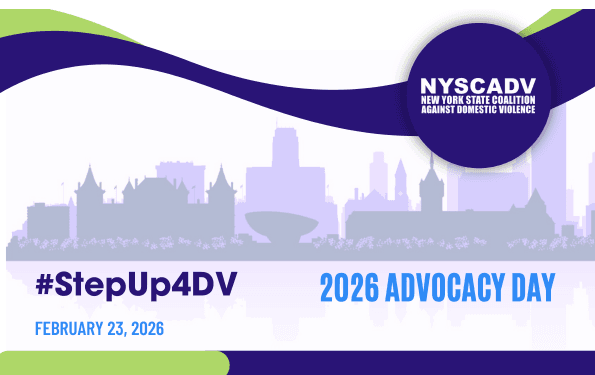
Please take a few minutes on Monday, February 23rd, to email your legislators and ask them to support the thousands of New Yorkers experiencing domestic violence every day. DV survivors require access to resources and services that can enhance their own safety, and the safety of their families, and rebuild their lives.
Below you will find a template email and link to talking points. We encourage you to tailor the sample email to highlight any other information you feel your legislators should be aware of (e.g., impacts to your program, what you are seeing in the field, nuances specific to DV programs and the victim/survivors you work with, etc.). When sending your email, please attach the supporting documents in the Legislator Packet (attached below).
Sample Outreach Email
Subject: NYSCADV’s 2026 Advocacy Day
Dear [Assembly Member/Senator + last name],
I am writing to you today as a/an [advocate, program director, executive director, etc.] at [your organization].
Domestic violence (DV) victim advocates, survivors, allies, and community members from across the state are joining together today for the New York State Coalition Against Domestic Violence’s (NYSCADV’s) 2026 Advocacy Day. Our message to state legislators is clear: Thousands of New Yorkers experience domestic violence every day. They require access to resources and services that can help them enhance their own safety, and the safety of their families, and rebuild their lives. By investing in critical, life-sustaining services, legislators can ensure survivors have the support they need to heal and move forward.
New York State consistently has the highest demand for domestic violence services in the country. More than 10,000 survivors seek services each and every day. However, years of inadequate funding have prevented DV providers from serving all those in need. An annual one-day assessment in 2024 found that more than 1,700 people were denied services due to a lack of resources – an increase of 64% from 2023. This is unacceptable. New York must do better. It’s time for New York to STEP UP for DV.
DV advocates are asking NY to step by:
- Creating $10 Million Emergency Contingency Fund to Stabilize DV Agencies Facing Potential Closure Due to Significant Cash Flow and Funding Issues
- Increasing Victim Services Appropriation by $25 Million to Address Federal VOCA Shortfall
- Strengthening NY’s Safety Net by Ending Competitive Procurements for Licensed DV Programs
- Increasing TANF Set-Aside for Non-Residential DV Services by $6.5 Million to Meet Current Demand
- Appropriating $3 Million for 7.8% Targeted Inflationary Increase on State DV Contracts
- Enhancing Shelter Access for Single Adult Survivors with SAFE Shelter Act (A3264/S7738)
If you would like more information, I can be reached at {phone number}, or you can contact Joan Gerhardt, Director of Public Policy and Advocacy at NYSCADV, at jgerhardt@nyscadv.org.
Sincerely,
{Your name and title}
Sample Thank You Email
After meeting in person or virtually with legislators, it is customary to send them an email thanking them for their time and support. Below you will find a template thank you email. We encourage you to tailor it to reflect the specific issues you discussed during your meeting.
Subject Line: NYSCADV’s Advocacy Day
Dear [Assembly Member/Senator + last name],
On behalf of [your organization], thank you for meeting with us during the New York State Coalition Against Domestic Violence’s 2026 Advocacy Day. We appreciated being able to share the needs of domestic violence survivors and service providers across New York State.
Your support is pivotal to ensuring domestic violence service providers and survivors of domestic violence have the resources and services they need to rebuild their lives and increase the safety of survivors and their families. As you know, according to the annual DV Counts nationwide survey conducted by the National Network to End Domestic Violence, on just one day in New York in 2024, more than 10,000 victims of domestic violence sought domestic violence services. More than 1,700 of these domestic violence survivors did not get the services they requested.
With your leadership, we can ensure trauma-informed, survivor-centered services are available and accessible to ALL New Yorkers experiencing domestic violence. Together, we reduce the unmet need and provide the support needed to domestic violence victims and their families.
If you would like more information on how domestic violence service providers and survivors are impacted, I can be reached at [phone number]. You can also contact Joan Gerhardt, Director of Public Policy and Advocacy at NYSCADV, at jgerhardt@nyscadv.org.
Thank you for your time and your leadership on behalf of domestic violence survivors in New York State.
Sincerely,
[Your name and title]
Legislator Packet Materials
-
Sample Legislator Letter
Click here to download an editable copy of this document.
September 22, 1998February 23, 2026
RE: NYSCADV’s 2026 Advocacy Day
Greetings Legislators!
Are you aware that thousands of New Yorkers experience domestic violence (DV) every day. In fact, New York State continues to have the highest demand for DV services in the country. According to a national survey, on one day in New York in 2024, more than 10,000 adult and child victims of DV sought help from New York’s DV service providers. More troubling, 1,717 of these victims did not receive the help they requested due to a lack of resources and staff – a 64% increase in unmet demand from the year before.
Why aren’t these survivors getting the help they need? New York relies almost exclusively on federal funding to support DV services. The federal government has taken several steps to cut or limit this funding. Most recently, it sought to freeze New York’s TANF and Title XX grants. New York uses $91 million of these grants to support DV services every year. Now that funding is in jeopardy. We urge the Legislature to set aside in its one-house budget bills $10 million of state emergency reserves to ensure all licensed DV programs can continue to operate under these challenging circumstances. In addition, DV programs facing insurmountable losses to facilities (due to natural disasters, fires, floods or major mechanical failures) should be able to access this funding so they don’t have to obtain high interest-bearing loans to rebuild or close their doors.
Additional budget recommendations include:
1. Increasing by $25 million the Governor’s earmark in the Aid to Localities (ATL) Budget
for OVS (page 1085) to address the federal VOCA shortfall;2. Strengthening New York’s safety net by ending competitive procurements for licensed
DV programs;3. Increasing the TANF set-aside for non-residential DV services by $6.5 million to meet demand and account for inflation increases over the last 25 years;
4. Providing a 7.8% Targeted Inflationary Increase on the total value of all NYS contracts with OCFS-licensed, primary purpose DV programs; and,
5. Enhancing shelter access for single adult survivors with the SAFE Shelter Act (A3264/ S7738).
More information about these requests is available on the accompanying documents. Please contact me at jgerhardt@nyscadv.org with questions.
Sincerely,

Joan Gerhardt
Director of Public Policy and Advocacy
-
NYSCADV Budget Priorities
-
This link will redirect you to NYSCADV's Coalition Manager Resource Manager for document preview and download.
DV Counts Summary
This link will redirect you to NYSCADV's Coalition Manager Resource Manager for document preview and download.
-
DV Counts Flyer
This link will redirect you to NYSCADV's Coalition Manager Resource Manager for document preview and download.